Source → process → microstructure → performance

Materials, from first principles.

Applied Elements develops advanced materials by controlling the path from natural resources and chemical precursors through processing, microstructure and application performance.

Scroll to examine
01First principles

The properties of a material begin long before the finished part.

Performance begins with which atoms are present, which impurities remain, how phases form, and what grains, pores, interfaces and defects emerge through processing.

01SourceOrigin / variability
02CompositionAtoms / impurities
03ProcessThermal / mechanical
04MicrostructureGrains / pores
05PropertiesMeasured behavior
06PerformanceIn application
Aerial view of a mineral quarry and processing landscape
Scale study / first principles01 / 03
10³ m / geological scale

Resource landscape

Origin establishes the chemistry, variability and constraints that every later process must control.

02Starting materials

Three beginnings.
Three material pathways.

Begin with the source. Engineer toward performance.

Representative quartz quarry and processing landscape
Telangana / IndiaOrigin 01
SiO₂

Quartz

Material pathway 01Quartz origin / Si–C–O system
Si–C–O

From controlled silica to engineered ceramic.

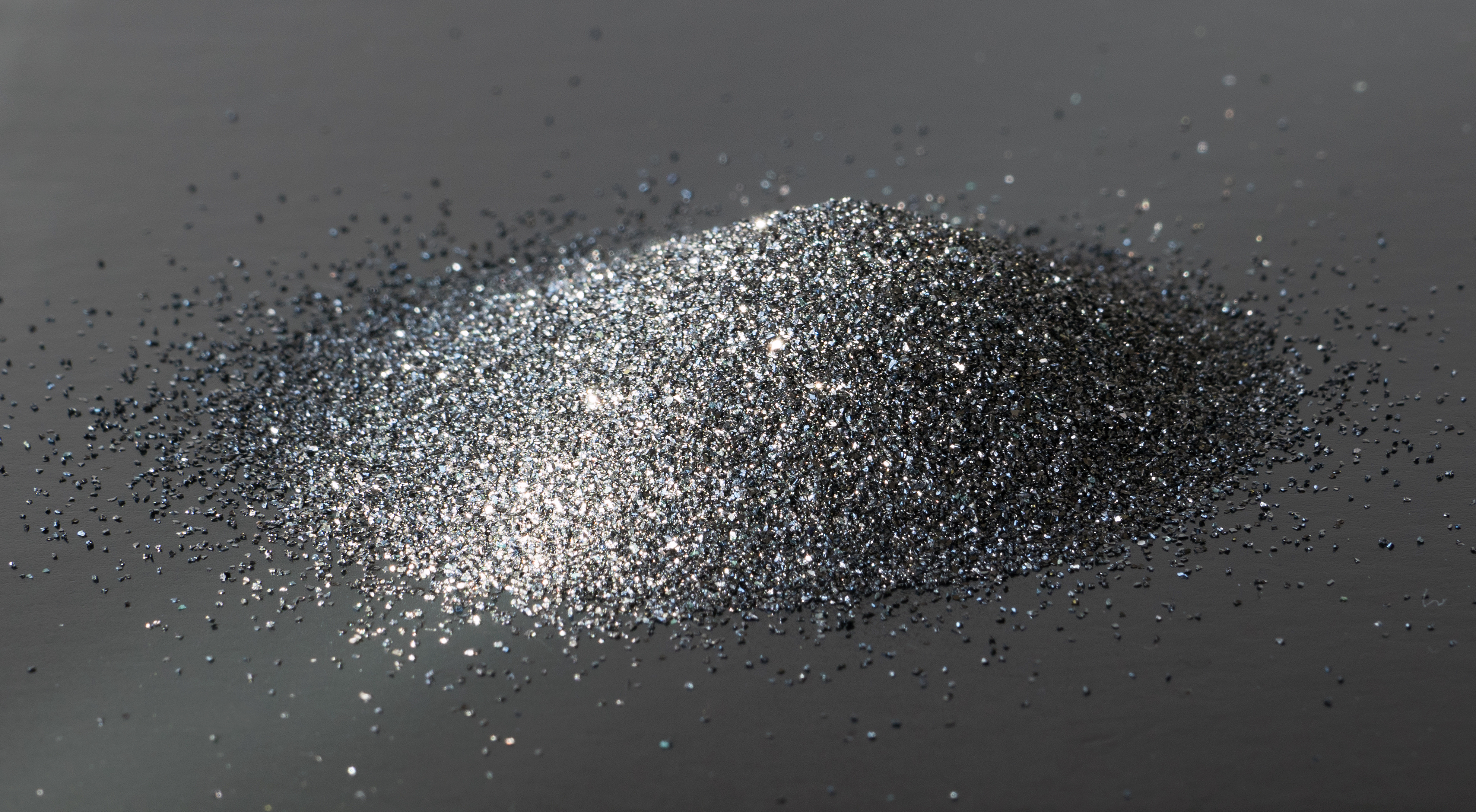
Beneficiation, purification and carbothermal conversion can reshape natural quartz into controlled silica, engineered SiC powders and ceramics. Impurity profile, morphology and densification are designed around the end use.

SiO₂ + 3C → SiC + 2CO
Irregular feedstock → controlled ceramic structure
Representative open-pit dolomite resource
Andhra Pradesh / IndiaOrigin 02
CaMg(CO₃)₂

Dolomite

Material pathway 02Dolomite origin / Ca–Mg–O system
Ca–Mg–O

Heat, reaction and cyclic stability.

Calcination transforms dolomite into a coupled CaO–MgO system. Particle architecture, porosity, strength and thermal history shape reaction behavior and high-temperature performance.

CaMg(CO₃)₂ → CaO + MgO + 2CO₂
Powder → granule → pellet → formed material
Representative lab-grown diamond crystals
Carbon / synthetic originPartner platform
C / sp³

Lab-grown
diamond

Material pathway 03Exploratory / partner-led
C

One element. Radically different properties.

Changing carbon bonding from sp² to sp³ changes hardness, heat transport and optical behavior. Applied Elements explores this system through partner expertise in synthetic diamond and advanced carbon.

C(sp²) ⇄ C(sp³)
sp²
sp³
Source discipline

The resource images are representative. Composition, variability and processing routes must be established through representative characterization and physical testing.

Thermal processingRepresentative furnace environment
AE-CMO-0247CaO–MgO / Batch 07900 °C / Cycle 100
03The materials engine

From resource
to performance.

Industrial processing, engineered materials and advanced R&D—connected by process knowledge and physical evidence.

01

Characterize

  • Sampling
  • Mineralogy
  • Chemistry
  • Phases
  • Defects
02

Process

  • Crushing
  • Beneficiation
  • Purification
  • Conversion
03

Engineer

  • Powders
  • Particles
  • Interfaces
  • Formulation
04

Form

  • Granulate
  • Pelletize
  • Press
  • Shape
05

Transform

  • Calcine
  • React
  • Sinter
06

Measure

  • Microstructure
  • Properties
  • Performance
07

Improve

  • Models
  • Experiments
  • Process data
  • Iteration
Industrial processing→Engineered materials→Advanced R&D
04Customer-backward design

Matter flows forward.
Knowledge flows backward.

Physical material advances toward the customer. Engineering information returns toward the feedstock—turning application requirements into process decisions.

01Matter
ResourceProcessMaterialCustomer
02Knowledge
FeedstockMicrostructurePropertiesPerformance
Representative scanning electron micrograph showing crack propagation in a ceramic composite
10 μm

Fig. 05 — Representative TaC/CNT/SiC micrograph / reference literature

Move to examine · Arrow keys supported
05Science + experimentation

Science that
closes the loop.

We combine physical models, structured experimentation and materials characterization to understand how chemistry and processing determine performance.

01Model→
02Make→
03Measure→
04Learn
ThermodynamicsKineticsPhase diagramsCALPHAD where usefulDOESimulationBayesian optimizationStructured experimental data
Use the right tool for the physical problem.
06Operating model

Built to move from
experiment to industry.

17.3850° N / 78.4867° E

Hyderabad
South India

The physical engine: mineral processing, materials R&D, powder and thermal processing, ceramic development, characterization, pilot manufacturing and scale-up.

Physical development
Application requirements
37.7749° N / 122.4194° W

San Francisco
United States

A deliberately small customer-facing node for application engineering, partnerships, company building, selected science and research relationships.

07Application environments

Materials for demanding
physical environments.

Directions under development—not claims of existing qualification—across thermal, chemical, mechanical and radiation-intensive systems.

01

Energy

Thermochemical systems / thermal storage

02

Extreme temperature

Furnace / kiln / hot-zone systems

03

Advanced industrial

Wear / corrosion / process equipment

04

Aerospace + defense

High thermal and mechanical loads

05

Semiconductor equipment

Thermal management / process environments

06

Nuclear / future systems

Radiation / temperature / lifetime

08Research notes

Working knowledge,
made legible.

An index of process notes, experimental frames and technical questions. Open each note to examine its material system, application frame and technical focus.

The long-term ambition

Raw matter
→ controlled matter
→ engineered performance.

Build the materials engine that can repeatedly ask what the customer needs, determine the required properties and microstructure, engineer backward toward the process and feedstock—and manufacture it economically and reproducibly.

Image credits

Hero: generated concept image. Quartz quarry: Shane Ryan Herilalaina / Unsplash. Dolomite quarry: Aleksandr Galichkin / Unsplash. Synthetic diamonds: 2x910 / CC BY-SA 4.0. Furnace: Yasin Hemmati / Unsplash. Industrial facility: Sweder Breet / Unsplash. SiC powder: W.carter / CC0. SEM powder: Nasry et al. / CC BY-SA 4.0. SEM composite: Xie & Wosu / CC BY 4.0. Images are representative and do not depict Applied Elements facilities, resources or products.